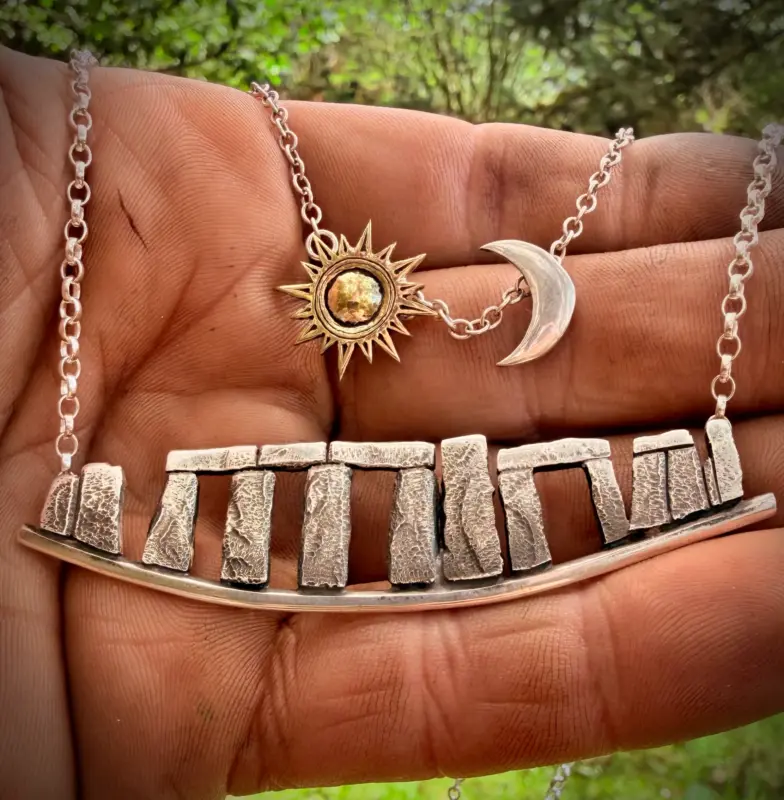

For thousands of years, people have made their way to windswept Salisbury Plain.
Long before roads.
They came to watch the sun.
Today, thousands still gather at Stonehenge during the summer and winter solstices arriving before dawn. Some carrying drums and banners. Others stand quietly among the stones. Each person makes the journey simply because they feel drawn there.
In an age of technological saturation, it seems more important than ever.
A Monument Older Than Memory
Stonehenge was already ancient when the Romans arrived in Britain.
The first earthworks appeared around 3000 BC. The great standing stones were raised centuries later, transported vast distances and carefully aligned with the movement of the sun.
Even today, archaeologists continue to debate exactly why it was built.
Was it a ceremonial site?
An observatory?
A place of healing?
A gathering place for scattered communities?
The truth is that nobody knows with certainty.
What we do know is that enormous effort was invested in its creation. Generations of people worked together to build something that would outlast them all.
That alone tells us something important.
Stonehenge matters.
The Solstice Connection
The most famous alignment at Stonehenge occurs during the summer solstice.
On the longest day of the year, the rising sun appears in alignment with the monument’s axis. During the winter solstice, the setting sun aligns in the opposite direction.
The builders clearly understood the rhythms of the heavens and incorporated them into the monument’s design.
For ancient communities, these celestial events carried profound meaning.
The summer solstice marked abundance, warmth and the height of the growing season.
The winter solstice marked survival. The return of the light after the darkest days of the year.
In a world governed by seasons, these moments mattered deeply.
The sun’s journey was not simply observed.
It was celebrated.
Why It Still Matters
Modern life has separated many of us from the natural rhythms that shaped human existence for thousands of years.
Electric lights blur the distinction between day and night.
Central heating softens the impact of winter.
Food arrives year-round regardless of season.
Yet beneath all of that, we remain creatures of the same earth and sky.
The sun still rises.
The seasons still turn.
Winter still gives way to spring.
Stonehenge reminds us of this.
Standing among the stones, it becomes impossible not to feel the scale of time. Generations have stood in the same place, watching the same sunrise, feeling many of the same hopes and fears.
The monument connects us not only to the past but to one another.
A Shared Human Story
Part of Stonehenge’s power lies in its mystery.
If we knew exactly why it was built, perhaps it would become merely an archaeological fact.
Instead, it remains open to interpretation.
People see different things within the stones.
Some see spirituality.
Some see history.
Some see astronomy.
Some simply see beauty.
Yet all are drawn by the same instinct: the desire to connect with something larger than themselves.
That instinct is as old as humanity itself.
The Endurance of Stone, Silver and Gold
Most things humans create eventually disappear.
Wood rots.
Man made metals like iron and steel corrode.
Buildings collapse.
Stonehenge endures.
Storms have passed over it.
Empires have risen and fallen around it.
Languages have changed.
Borders have shifted.
The stones remain.
There is something reassuring about that permanence.
In a fast-moving world, ancient monuments remind us that not everything is temporary.
Some things are worth building to last.
Why We Still Gather
Perhaps we gather at Stonehenge for the same reason our ancestors once did.
Not because we fully understand it.
But because we recognise something of ourselves there.
The monument reminds us that we belong to a story much older than our own lives.
A story written in sunlight, seasons and stone.
A story that began long before us and will continue long after we are gone.
Each solstice, as the sun rises above Salisbury Plain and light touches the ancient stones once more, people continue to gather.
Not because Stonehenge belongs to the past.
But because it still speaks to the present.
And perhaps it always will.