
Why Traditional Engraving Still Matters
There is a particular beauty in marks made slowly.
Hand engraving is not decoration applied at the end of making; it is an act of commitment. Each line is cut deliberately into metal, removing material that can never be put back. Unlike surface finishes or printed patterns, engraving alters the object permanently — it becomes part of the silver itself.
This is why hand engraving has always carried weight. It asks for time, patience, and certainty. And in a world of shortcuts, that alone makes it precious.
What Hand Engraving Really Is
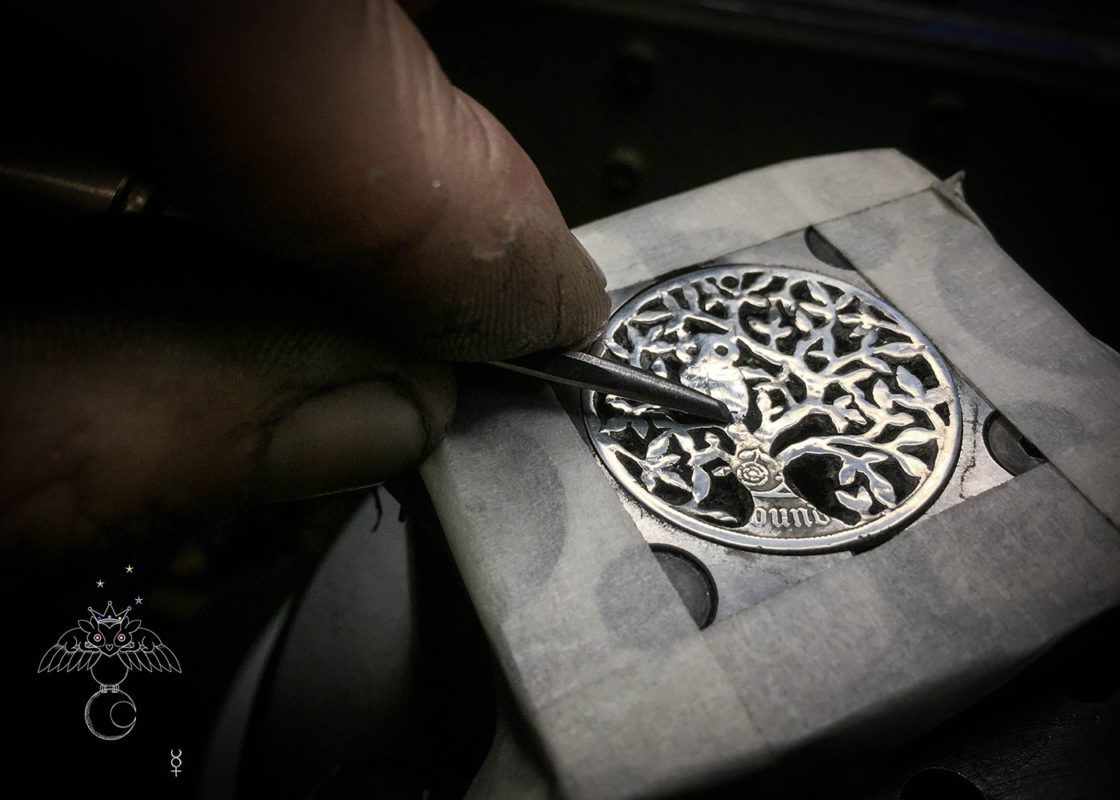
Traditional hand engraving is the process of cutting lines directly into metal using hardened steel gravers, guided entirely by hand.
There are no resets.
No undo.
No soft edges.
Each cut must be placed with intention, pressure, and control. The engraver reads the resistance of the metal through their fingers, adjusting angle and force moment by moment. The work progresses line by line, rhythm by rhythm.
Engraving is closer to drawing than carving — but instead of graphite on paper, the medium is silver, and the drawing is permanent.
English Scrollwork — A Language of Line
Traditional English scroll engraving is one of the most recognisable and refined engraving styles.
It grew from centuries of craft — seen on antique silverware, firearms, watch cases, seals, and jewellery — and is built on flow rather than symmetry. Scrolls unfurl, turn back on themselves, taper, widen, and disappear, creating movement across the surface.
Good scrollwork does not feel mechanical.
It breathes.
Each flourish is designed to lead the eye forward, never stopping abruptly, never crowding the space. The best examples feel almost inevitable — as though the metal always wanted those lines to be there.
Flourish as Restraint, Not Excess
Despite its elegance, traditional scrollwork is not about ornament for ornament’s sake.
True flourish is restrained.
An engraver must decide when not to cut — when a surface needs space to rest. The relationship between engraved line and untouched silver is what gives scrollwork its quiet authority. Too much, and it becomes noise. Too little, and it feels hesitant.
This balance can only be learned through practice, patience, and respect for the material.
Why Engraving Cannot Be Replaced by Machines
Modern engraving machines and lasers can replicate patterns, but they cannot replicate decision-making.
A machine follows instructions.
A hand responds to the metal.
Hand engraving adapts to:
- variations in alloy and hardness
- subtle movement in the work
- the way light will fall across a surface
These micro-adjustments are invisible in isolation, but together they give engraved work its life. This is why antique engraving still feels warmer, deeper, and more human than perfect modern reproductions.
Imperfection is not a flaw here — it is evidence.
Engraving as Conversation with Time
Engraved silver ages differently.
As a piece develops patina, engraved lines deepen visually. Shadows grow richer, highlights soften, and the design becomes more legible rather than less. The engraving does not fade — it emerges.
This is one reason engraving has always been favoured for objects meant to last: heirlooms, personal jewellery, ceremonial pieces. The marks improve with age, just as the metal does.
Why We Still Engrave by Hand
In the Hairy Growler workshop, engraving is not used to impress — it is used to honour.
A hand-engraved line carries:
- the decision to slow down
- the acceptance of permanence
- the willingness to let the hand be seen
Whether it is a subtle scroll flourish, a textured detail, or a quiet accent, engraving connects the finished piece to the moment it was made.
It is proof that someone was there.
A Craft That Refuses to Hurry
Hand engraving has survived because it does not compete with speed.
It exists outside urgency.
Outside trends.
Outside mass production.
It rewards those who look closely — and those who wear pieces long enough to understand them.
In silver, engraving is not an embellishment.
It is a conversation — between hand, metal, and time.
Carried Forward
Traditional hand engraving — and English scrollwork in particular — endures because it speaks softly and lasts well.
It reminds us that beauty does not need to shout,
and that the most meaningful marks
are often the ones cut slowly.
To explore engraved, hand-worked silver jewellery shaped by traditional techniques, visit Our Craft & Inspiration.
