Brief Summary…
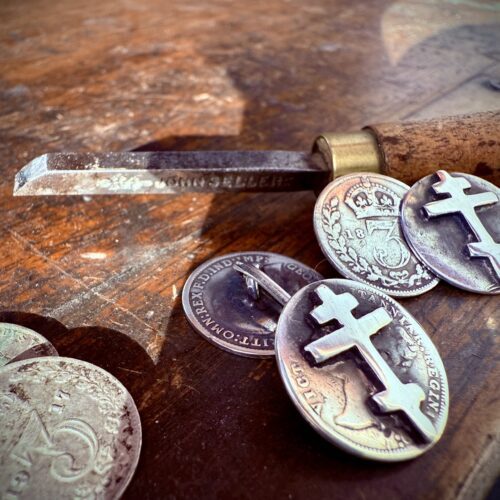
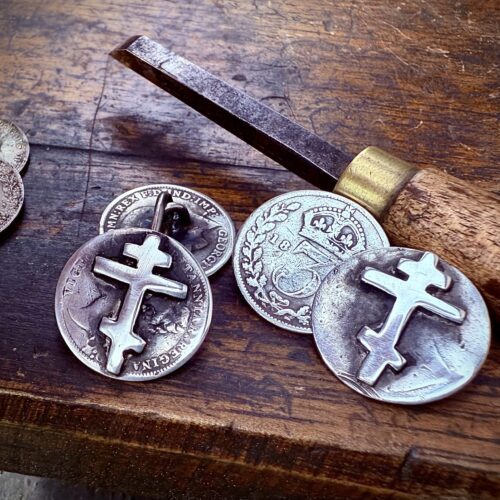
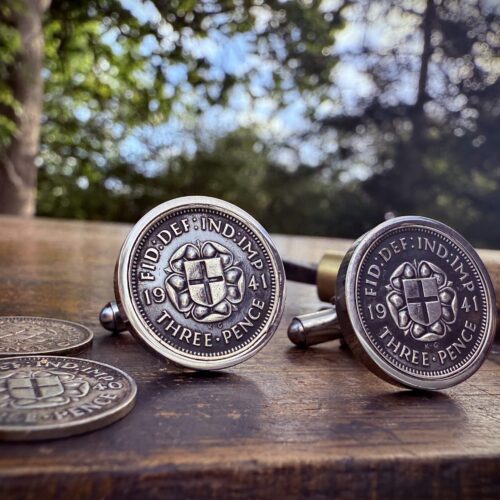
- Six sterling silver threepence coins circa early 1900’s
- Meticulously hand cut, carved and polished to perfection
- Made using only traditional hand tools and techniques
- Optional engraved initial on reverse
- Symbolism: Orthodoxy, one true Church, love, faith and hope in Jesus Christ
- Handcrafted & Recycled in Cambridge
- Made carefully with Love
- size : approx 16mm
Recycled silver coins
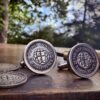
These beautiful Orthodox Cross cufflinks are a lovely gift for both you and the special person in your life. They have been recycled from six English sterling silver threepence coins.. These coins are unwanted by coin collectors due to wear marks from being used to buy and sell over one hundred years ago.
Rather than let them simply be melted down for the silver content I absolutely love coming up with designs and ideas to transform them into something desirable. By doing this the historical details are retained, simultaneously adding depth, interest and intrigue to the design.
The Orthdox Crosses have been individually hand cut and carved from the silver shillings with a traditional jewellers saw. The opposite side of the cufflink is the sterling silver three pence. These coins are perfect as not only the size is ideal but also the ‘3’ represents the perfect Trinity symbolism.
The Orthodox Christian cross is a rich and complex symbol, the symbol of all symbols, reflecting not just Christ’s crucifixion, but the entire narrative of our salvation. Unlike many Western crucifixes that focus on the agony of the crucifixion, the Orthodox cross emphasizes Christ’s victory over death, portraying a triumphant King of Glory rather than a suffering victim.
The topmost bar is the title-board, or titulus, placed over Christ’s head. In Orthodox tradition, it is often inscribed with the initials INBI, from the Greek for “Jesus of Nazareth, King of the Jews.” Poetically, this serves as a divine and ironic crown, a worldly title that unwittingly proclaims Christ’s true spiritual kingship. In some traditions, the inscription may be the more triumphant “King of Glory”.
The middle bar is the main horizontal bar upon which Christ’s hands were nailed. It represents the central act of the Passion and the divine sacrifice. Poetically, it marks the pivotal moment of divine love and obedience, where the suffering of God brings salvation to the world.
The bottom, slanted bar is the suppedaneum, or footrest, and it is perhaps the most unique and symbolic element of the Orthodox cross. Its slant conveys the “Scales of Justice” at the time of Christ’s death. The side that points toward the repentant thief (St. Dismas), who was crucified on Christ’s right and earned a place in Paradise, points toward heaven. The side that points toward the unrepentant thief, who mocked Christ, points toward hell. This points to the individual’s choice in the face of Christ’s sacrifice—a choice between repentance and rejection that determines their ultimate destiny.
A skull and bones are often depicted at the foot of the cross, symbolizing the “Place of the Skull,” or Golgotha, where Christ was crucified. Poetically, this represents a theological tradition that Christ’s cross was planted directly over the burial place of Adam. As Christ’s blood seeped down and washed over Adam’s bones, it symbolically washed away the original sin of humanity. This transforms the cross into a bridge between the first Adam, who brought sin, and the “New Adam,” Christ, who brings salvation.
Jesus Christ’s crucifixion was not a defeat but a victory. The cross is “the tree of life,” reversing the poison of the forbidden tree in Eden. In this view, Christ’s death is the means by which he tramples down death by death, and his crucifixion is already the start of his triumph.
The sun and moon are often shown in icons of the crucifixion, signifying that this was a cosmic, world-changing event. The sun darkens and the moon turns to blood to reflect the immense gravity of the moment.
Orthodox Christians make the sign of the cross as a physical prayer, with the three joined fingers representing the Holy Trinity. This action and the symbol of the cross itself represent the path of ascetic struggle, victory over temptation, and the ultimate resurrection that leads to eternal life.
The cross represents Christ’s supreme humility in his suffering, and his ultimate glory in his resurrection. This paradox is at the heart of Orthodox theology and spirituality, which sees glory in self-emptying and triumph in sacrifice.
Handcrafted & Recycled in Cambridge, UK.
Size : Approx 16 mm





Reviews
There are no reviews yet.