a little more detail….
The Willow of the Old Silver
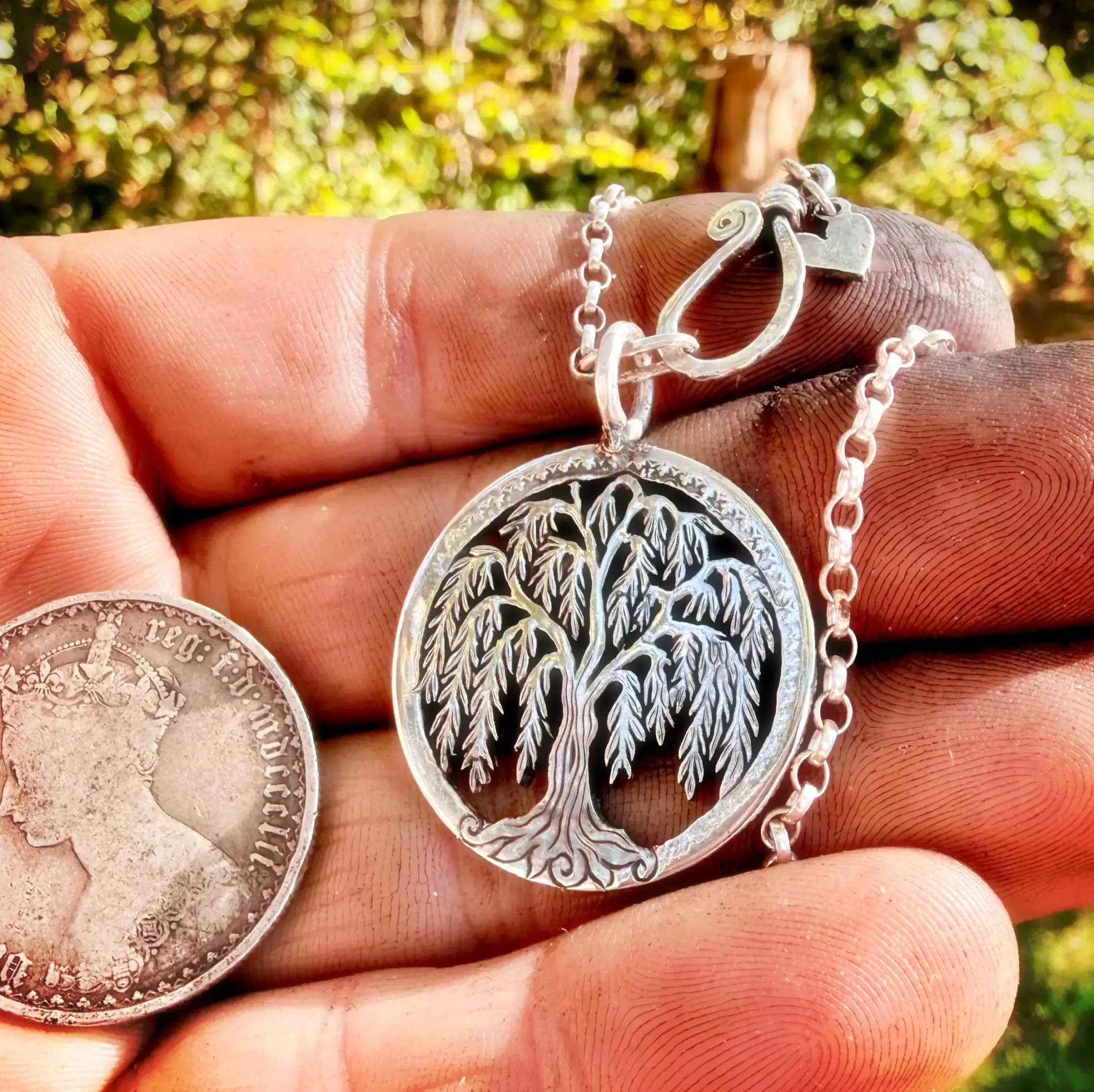
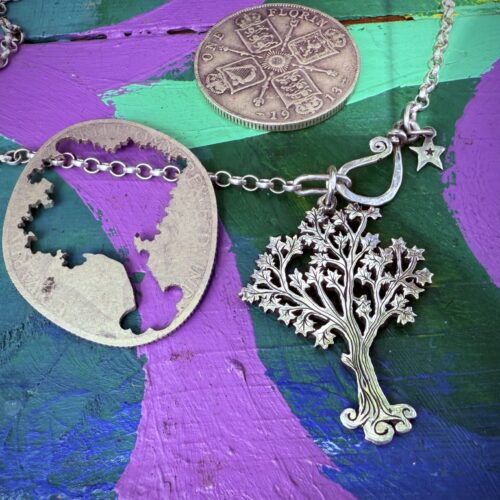
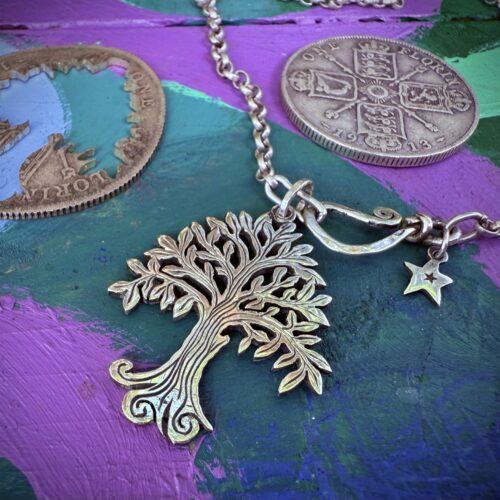
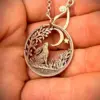
A Weeping Willow Hand Pierced from a Beautifully Worn 1870s Gothic Silver Florin
Sometimes an old coin arrives at the bench that is simply too beautiful to make new again.
This was one of them.
A Victorian Gothic florin from the 1870s.
Its portrait softened.
Its lettering worn.
Its surface carrying more than a century and a half of handling.
Silver that has travelled through Victorian Britain and somehow survived long enough to reach my hands.
I could have polished away much of that history.
I didn’t.
Instead, I drew a willow tree inside it.
And began cutting.
A Hairy Growler Canon Piece
There are old coins that provide material.
And there are old coins that become part of the story.
This Gothic florin is very much the latter.
The worn surface matters.
The surviving Victorian detail matters.
The old edge matters.
Even the places where generations of fingers have slowly softened the coin matter.
So the willow has not been placed over the history of the florin.
It has been made within it.
The tree is new. The silver beneath it has already lived a very long life.
The Gothic Florin
The Gothic florin is one of the most distinctive coins of Victorian Britain.
Introduced during the reign of Queen Victoria, it belongs to a remarkable period of nineteenth-century British coin design.
The name by which collectors now know it comes from the medieval-inspired style of the portrait, lettering and ornament used on the coin.
It is elaborate.
Romantic.
Unmistakably Victorian.
And after more than 150 years, beautifully imperfect.
I wanted enough of that old coin to survive that you can still see where the willow came from.
1870s Silver
There is something difficult to comprehend about holding a piece of silver this old.
When this florin was currency, Queen Victoria was on the throne.
It belonged to a Britain of steam, gaslight, railway stations, handwritten letters and coins carried loose in pockets.
This particular florin was not hidden away untouched for a collector.
It was used.
You can see it.
The high points have softened.
Details have faded.
The surface has been changed by touch.
That is precisely why I chose it.
This coin does not merely come from the 1870s. It looks as though it has travelled here from them.
The Willow
And from that old Victorian silver grows a willow.
Not a perfectly symmetrical tree.
Not a botanical diagram.
A willow shaped by weather.
Its trunk rises from exposed roots.
Branches divide and turn.
Long leaves fall towards the earth.
There is movement everywhere.
The tree appears still at first.
Look again and almost every line is bending.
That is the willow’s particular kind of strength.
The Tree That Bends
Willow has long been associated with resilience, adaptability, intuition and renewal.
It does not meet every storm by trying to remain rigid.
Its branches yield.
They move.
They bend under weight and weather.
And when the wind passes, the tree remains.
There is a lesson in that which feels increasingly valuable.
Strength does not always mean refusing to bend.
Sometimes survival comes from knowing how.
Willow and Water
Willows have an intimate relationship with water.
We find them beside rivers, streams, ponds and wet ground, their branches hanging towards the surface.
That association has helped connect willow with emotion, intuition and the quieter, reflective parts of human experience.
Water moves.
Willow moves with it.
Neither needs to remain fixed in order to endure.
In this pendant, even without a river beneath the tree, I wanted some of that fluidity to remain.
The leaves fall almost like water themselves.
The Weeping Willow
Of course, the willow also carries another association.
Remembrance.
Loss.
Grief.
For centuries, the weeping willow has appeared in art and memorial imagery as a symbol of mourning.
Its bowed branches seem almost human.
Yet I have never thought of the willow as a sad tree.
There is something more complicated happening.
It bows.
But it continues growing.
It remembers.
But it remains alive.
Perhaps that is why it became such a powerful symbol of grief. It holds sorrow and continuation at the same time.
Renewal
Willow also has an extraordinary ability to regenerate.
A cut branch placed into suitable damp ground can take root and begin again.
That physical ability to renew itself has naturally helped the tree gather associations with rebirth and recovery.
Cut back.
It grows.
Bent.
It returns.
Broken from the parent tree.
It may put down roots of its own.
There are worse symbols to carry through life.
A Tree from an Old Coin
There is another kind of renewal happening here too.
The florin had finished the life it was made for.
It was no longer money.
Its original purpose had disappeared generations ago.
But the silver remained.
So instead of melting it into anonymous metal, I kept the coin intact and began another life within it.
A Victorian florin became a willow tree.
Renewal expressed not only by the design, but by the material itself.
The Tree Was Hidden Inside
I don’t cast the willow and attach it to the coin.
I don’t stamp the design onto its surface.
And I don’t melt the florin down first.
The tree and the old coin remain one continuous piece of silver.
I begin by drawing the design onto the florin.
Tiny entry holes are then drilled into the spaces between the branches, leaves, roots and trunk.
A very fine jeweller’s saw blade is threaded through each opening.
Then the background begins to disappear.
One opening.
One branch.
One leaf.
One tiny section at a time.
The tree is not placed onto the coin. It is released from it.
A Forest of Tiny Decisions
Look closely at the willow.
Almost nothing is straight.
Every branch divides.
Every cluster of leaves needs space around it.
Every opening has to leave enough silver behind to keep the tree strong.
Cut a fraction too far and a branch disappears.
Make an opening too large and the balance of the tree changes.
Make it too small and the light cannot get through.
There is no computer-controlled cutter correcting the line.
Just a tiny saw blade following a drawing through nineteenth-century silver.
Hundreds of little decisions hiding inside one tree.
The Roots Stay
I particularly wanted the roots to be visible.
They curl across the bottom of the old florin, anchoring the tree into the remaining rim.
They are structural.
But they are symbolic too.
We talk about roots when we talk about family.
Home.
Heritage.
Belonging.
The things that came before us.
That feels particularly appropriate when the roots themselves are made from Victorian silver.
An old material becoming the roots of something new.
Look at the Edge
One of my favourite details is not the willow at all.
It is the surviving rim around it.
That circle tells you the tree was once something else.
Fragments of the old coin remain visible.
Little marks and details survive around the edge.
Without them, this could simply be a silver tree pendant.
With them, the object reveals its previous life.
Look closely enough and the florin is still there.
I Left the Wear
This was never intended to become a pristine Victorian coin again.
The wear is part of why I chose it.
More than 150 years have softened its surfaces in a way I could imitate, but never truly reproduce.
That wear came slowly.
A pocket at a time.
A transaction at a time.
A hand at a time.
So I have allowed the old silver to retain its age.
I make the tree. Time makes the surface.
Made Slowly at the Hairy Growler Bench
This is the sort of piece that reminds me why I still like making jewellery by hand.
There is no sensible shortcut to it.
The coin has to be studied.
The tree drawn.
The holes drilled.
The saw threaded.
The spaces individually pierced.
The edges refined.
The trunk carved.
The bark suggested.
The leaves detailed.
The roots shaped.
And then the whole piece needs to be finished without polishing away the very history that made the old florin worth using.
Slow craft for slow-grown silver.
The Maker Stays in the Piece
If you look closely, you will see that this willow is not mechanically perfect.
Nor should it be.
The branches do not mirror one another.
The leaves vary.
The trunk twists.
My saw line and engraving tools have left tiny traces behind.
Those are not manufacturing defects to be eliminated.
They are evidence of how the object came into existence.
You should be able to look at handmade jewellery and know that hands were there.
More Than 150 Years Apart
There is something I find quietly extraordinary about working this way.
The people who made this florin and the person cutting the willow into it are separated by more than a century.
Different workshops.
Different tools.
Different Britain.
Different reasons for working the silver.
Yet both sets of hands now exist within the same object.
The Victorian mint made the coin.
Time wore it.
I made the tree.
And eventually someone else will add the next layer simply by wearing it.
For Someone Who Has Bent but Not Broken
There are many reasons someone might choose a willow.
Perhaps it represents resilience.
Perhaps recovery.
Perhaps remembrance.
Perhaps a family whose roots run deep.
Perhaps a period of enormous change that required learning when to stand firm and when to bend.
Or perhaps there is simply a willow somewhere that matters.
Beside a childhood river.
At the bottom of a garden.
On a favourite walk.
Near a place that still feels like home.
The tree brings its symbolism. The wearer brings the meaning.
A Future Heirloom with a Victorian Past
I often describe certain pieces as future heirlooms.
This one is slightly different.
It was already old before I began.
The silver has already survived around a century and a half.
It has already belonged to another age.
Now the coin has been given another purpose.
Perhaps the willow will be worn for decades.
Perhaps one day it will pass to someone else.
And perhaps that person will look at the softened old rim and wonder about all the lives the silver passed through before reaching them.
Not a new heirloom pretending to have history.
An heirloom whose history began long before the jewellery did.
Product Details
- Original Hairy Growler willow tree necklace
- Handcrafted from a genuine 1870s British Gothic silver florin
- Original Victorian silver coin retained as the foundation of the pendant
- Willow tree individually designed and pierced by hand
- Intricate branches, leaves, trunk and exposed roots individually worked and refined
- Traditional fine jeweller’s saw used to remove the background section by section
- Hand engraving and carving used to create bark, leaf and root detail
- Original outer coin rim and surviving historic details deliberately retained
- More than 150 years of natural wear and surface character preserved where appropriate
- No two old coins or hand-pierced trees will ever be exactly alike
- Supplied with a handcrafted silver necklace fitting
- Optional sterling silver necklace chain
- Hairy Growler handmade Shepherd’s Crook fastening with suitable silver chain options
- Associated willow symbolism includes resilience, adaptability, renewal, remembrance, intuition and deep roots
- Individually handcrafted at the Hairy Growler bench
The Willow of the Old Silver
Once, it was money.
A Victorian florin changing hands in a world that has almost completely disappeared.
It travelled.
It was spent.
Its portrait softened.
Its details faded.
And eventually its life as currency ended.
But the silver remained.
More than 150 years later, it reached my bench.
I drew a tree across its worn surface.
Drilled the first tiny hole.
Threaded through my saw.
And slowly began taking the empty spaces away.
Until an old Victorian coin became something else.
Not younger.
Not restored.
Renewed.
The old rim became its boundary.
The Victorian silver became its branches.
The wear became its weather.
And at the bottom of it all, the roots remained.
The Willow of the Old Silver.
Deep roots. Bending branches. More than 150 years of life already behind it.






Reviews
There are no reviews yet.